

- Past Events
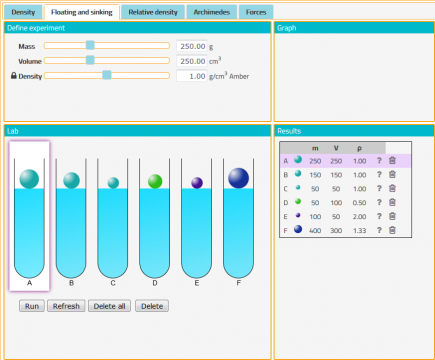
Go-Lab’s virtual buoyancy lab “Splash”, along with the Hypothesis Scratchpad tool and the Experiment Design tool were introduced to a class in the Netherlands March 24th-March 25th 2014 to test the handling and the functionality and gather useful feedback from the students.
After an introduction to the subject of Archimedes’ principle in the first session, the 22 students aged around 14 years old, had to work in the second session with the Hypotheses Scratchpad tool and the Experiment Design tool to build their own hypotheses on sinking and floating of the objects and build an experimental Design they could use to test their hypotheses. In the third session then, the students worked with the Splash virtual lab. A survey on the usability was also completed by the students in the last two sessions.
The Hypothesis Scratchpad proved to be a very useful tool to help the students with their building of hypotheses for their experiments. It helped them to work in a well-structured way, either by using the items that already existed or by inspiring them with the existing examples to build their very own hypotheses. Some critics on the Experiment Design tool were mentioned: it seemed to be a bit of a challenge to use the tool correctly without having seen the Splash Lab before. Also the little adjustment options the tool offered have been criticized, which is the subject to be improved in the future. The Splash lab itself found great support as it helped the students to learn interactively and enjoy it like a game.
Overall, there seemed to be hardly any problems in using the tools and the lab. With a few adjustments at some points, the Splash lab, along with the Hypothesis Scratchpad and Experiment Design tool can be easily introduced and used in other classes.